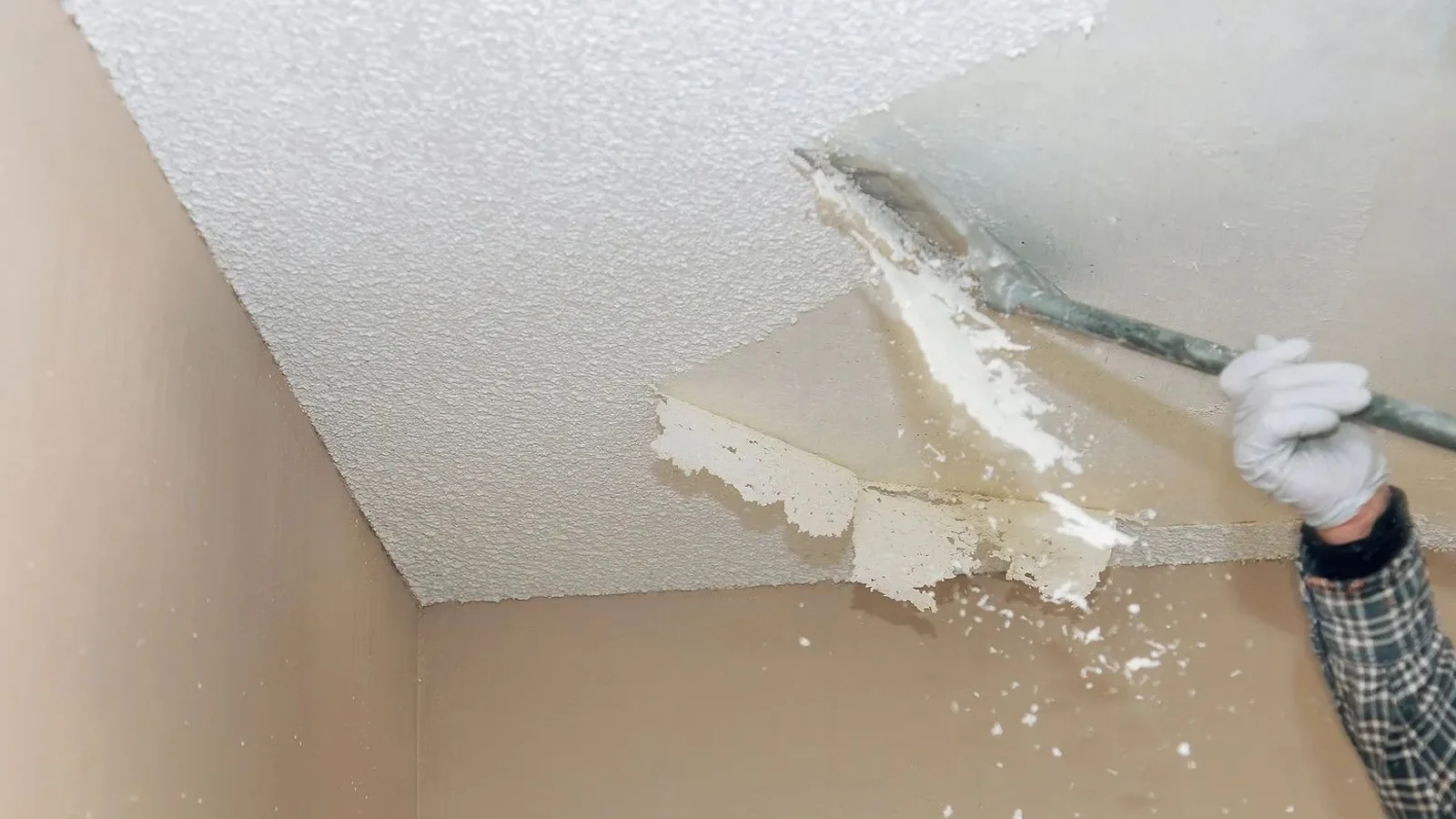
Half the houses in Buncombe and Henderson counties built between the mid-sixties and the mid-eighties still have their original sprayed ceiling. People live with them for decades and then one day decide they have had enough. It is a good decision — a flat ceiling makes a room look taller and newer than almost anything else you can do for the money — but it is worth knowing what the job actually is before you start moving furniture.
Start with the age of the house, because this is the part that is not negotiable. Ceiling texture sprayed before the early 1980s can contain asbestos. You cannot tell by looking, and scraping an asbestos-containing ceiling dry releases fibres through the whole house. A lab test on a small sample is inexpensive and takes a few days. If your house could be that age, have it tested before anyone quotes the job — and if a contractor offers to scrape it without testing, that tells you something about the rest of their work.
Assuming it tests clear, the first real day of work is not scraping. It is sealing. Floors covered and taped, walls sheeted, doorways sealed, every supply and return vent taped shut, light fixtures dropped or bagged, ceiling fans off and covered. This is what separates a job you barely notice from one that puts a grey film on every surface in the house for a month. If the crew arrives and goes straight up a ladder with a scraper, stop them.
Then the texture comes off wet. The ceiling is sprayed with water, given a few minutes to soak, and scraped in small sections so the texture comes away in wet sheets onto the plastic below instead of hanging in the air as dust. It is slower than dry scraping and it is the only civilised way to do it. Painted popcorn is harder — the paint seals the texture against water — and sometimes has to come off in a more laborious way, which is a thing the estimate should say out loud rather than discover on the day.
What is underneath is the part nobody plans for. Texture was often sprayed over a very rough level-1 or level-2 ceiling, because the texture was doing the hiding. Once it is off you will usually find joints that were never properly coated, tape that has lifted, nail pops, and sometimes an old water stain or a patch from a long-forgotten leak. All of that has to be repaired, then the ceiling skimmed — usually two coats — and sanded flat before it is anything you would want to paint. Budget for it, because it is not an upsell, it is the job.
Then the room is unsealed and cleaned, and you get a flat ceiling ready for primer. Some people want a light knockdown or orange peel instead of smooth, which is a legitimate choice and a little cheaper than skimming to smooth, and it hides seasonal movement better in a house that flexes.
How long? A typical bedroom is two to three days including drying time between skim coats; a large open-plan living area is a week. Anybody who tells you a whole house in two days is either not sealing properly or not skimming properly.
Thinking about it? Call Leo Drywall at (828) 470-2243. We'll tell you whether the house needs testing first, what your ceiling is likely to look like underneath, and what the whole job costs — free, and in English or Spanish.