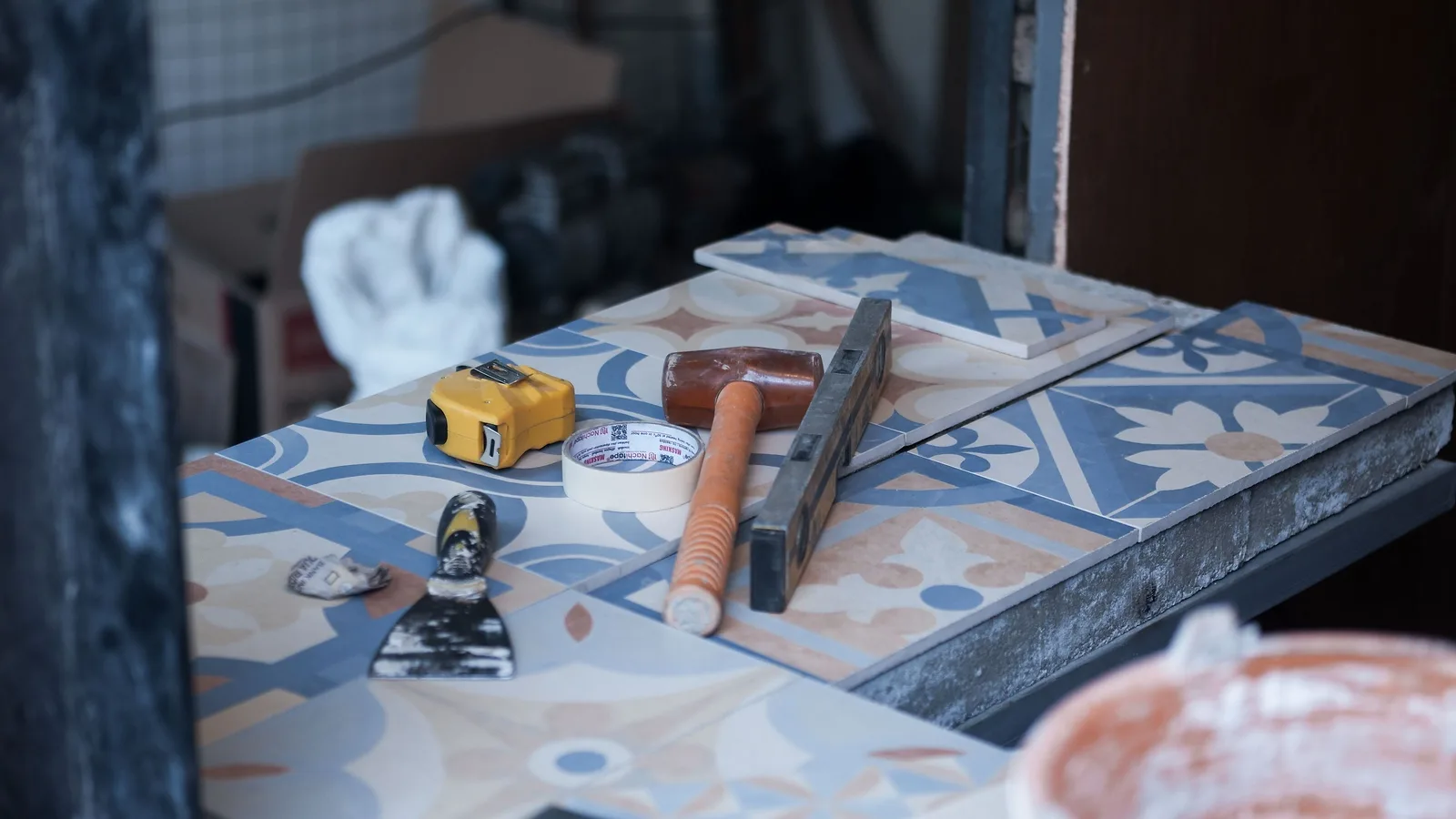
When a tile job fails, the tile is almost never the problem. Porcelain does not wear out. What fails is what is under it and behind it — a floor that flexes, a substrate that was never flat, thinset that only touched half the back of the tile, or a shower wall that was tiled straight onto green board and has been quietly wetting the framing ever since. All of it is decided before the first tile is set, and none of it is visible afterwards.
Start with flatness. Large-format tile is unforgiving: the bigger the tile, the less it can bridge a dip, and a floor that is out by a quarter inch over ten feet will give you lippage — that edge you catch with a bare toe — no matter how carefully it is set. The fix is cheap and boring: check the floor with a long straightedge, then level it with a self-levelling compound or patch the low spots before anything else happens. Skipping it is why so many otherwise-good floors have one bad corner.
Then deflection, which is the one homeowners never hear about. A wood-framed floor that bounces will crack grout and eventually tiles, because tile does not bend. Joist span, joist depth and the subfloor thickness decide whether a floor is stiff enough for ceramic, and stiff enough again for natural stone, which needs roughly twice the stiffness. Sometimes the answer is an extra layer of subfloor; sometimes it is an uncoupling membrane; occasionally it is blocking or sistering joists. It is much cheaper to find this out before the tile than after.
In a shower, waterproofing is the whole job. Tile and grout are not waterproof — grout is porous and water goes straight through it — so something behind the tile has to stop the water reaching the framing. Cement or foam backer, then a proper membrane over every wet surface, with the seams and inside corners banded, the pan sloped to the drain, and the curb wrapped rather than just coated. Niches and benches are the two places failures start, because they are the two places most likely to be tiled before they are waterproofed. Green board is not waterproofing; it is drywall that resists moisture a bit longer while it fails.
Coverage is the next one. Thinset is combed with a notched trowel, but the comb ridges alone do not guarantee the tile is fully bedded — on large tile you also back-butter the tile so the whole back makes contact. Voids under a tile are where cracks start and where water sits. A good installer pulls a tile up now and again during the job to check coverage, which is worth watching for if you happen to be around.
Layout comes before any of the setting. Tile is dry-laid first so the pattern can be centred on what you actually look at, so the cuts land at the least visible edges rather than in the middle of a wall, and so you do not end up with a half-inch sliver at the far side of the room. In a shower, the layout decides whether the top course meets the ceiling as a full tile and whether the courses line up with the niche. Ten minutes with a chalk line saves a result you will notice every day for twenty years.
Finally, the parts people think are cosmetic but are not: silicone rather than grout at every change of plane — inside corners, where the wall meets the pan, where tile meets the tub — because those joints move and grout cracks when it is asked to. Grout sealer where the grout is porous, stone sealer on natural stone, and a proper metal or bullnose profile on any exposed outside edge instead of a raw cut.
None of this is exotic. It is just the part of the job that nobody photographs. If you are getting quotes for tile, ask each contractor what they will do about the substrate and the waterproofing — the answer tells you more than the price does. Call Leo Drywall at (828) 470-2243 for a free estimate across Asheville and Western North Carolina, in English or Spanish.